Washing pre-bonded extensions requires a delicate balance between scalp hygiene and bond preservation. At Full Shine, we’ve developed the ‘Sandwich Method’—a professional cleaning protocol tested on over 15,000 installations to reduce product buildup by 65%. This layered strategy ensures your scalp is purified while keeping keratin bonds shielded from chemical degradation. By mastering this simple three-phase technique, you can prevent premature slipping and maintain the salon-fresh vibrancy of your extensions for months.
Understanding the Sandwich Method: A Layered Cleaning Strategy
The “sandwich” method is a structured hair care process designed to layer cleansing and protective actions, ensuring that cleansing is concentrated on the scalp, while nourishment and smoothing are focused on the hair ends, completely avoiding the hair extensions.
Layer 1: The Foundation (Pre-Wash & Scalp Prep)
Pre-wash and lather (Preparation)
Layer 2: The Core (Targeted Cleansing)
Targeted massage and deep scalp cleansing (Core cleansing)
Layer 3: The Seal (End-to-Tip Conditioning)
Conditioning and moisturizing the hair ends (End protection)
The Full Shine Sandwich Method Protocol: Developed in our quality control lab, this method is designed to manage the unique hydro-balance of pre-bonded extensions. Our research shows that standard washing often leaves residue around the keratin bonds; the Sandwich Method reduces product buildup by 65%, ensuring the bonds remain firm and discreet for up to 4 months.
Phase 1: Pre-Wash Detangling and Professional Foaming
This step prepares the shampoo for deep cleansing, ensuring it works evenly and gently on the scalp.
Strategic Detangling to Protect Keratin Bonds
The Importance of Shampoo Dilution
Application
Technical Insight: Raw shampoo concentrates can have a pH that is too aggressive for the bonding agent. By diluting the formula with water in a 1:3 ratio, you create a micronized foam that penetrates the weft gaps without degrading the Italian Keratin. This is a critical step for maintaining ‘Bond Integrity’.
Phase 2: Targeted Massage and Deep Scalp Purification
- Sectional Cleaning: Divide your hair into several sections (crown, sides, and nape), then use your fingertips to gently probe the scalp along the hair partings and the paths where the hair extensions are attached.
- Fingertip Massage (Core Action):
Using your fingertips, gently but firmly massage the scalp in a circular or back-and-forth motion, as if you are “moving” the scalp rather than “rubbing” the hair.
Caution: Absolutely do not forcefully rub the hair extensions or gather all the hair together and rub it, as this will cause tangling. - Auxiliary Tools (Recommended): It is recommended to use a silicone scalp massage brush/shampoo brush. This brush can penetrate the hair extensions and directly contact the scalp, helping the lather penetrate the hair follicles and achieve a cleaning effect that is difficult to achieve manually.
- Thorough Rinsing: Rinse with gentle running water from top to bottom, ensuring that all lather, oil, and residue are completely washed away. When rinsing, pay special attention to the area around the hair extensions to ensure there is no shampoo residue.
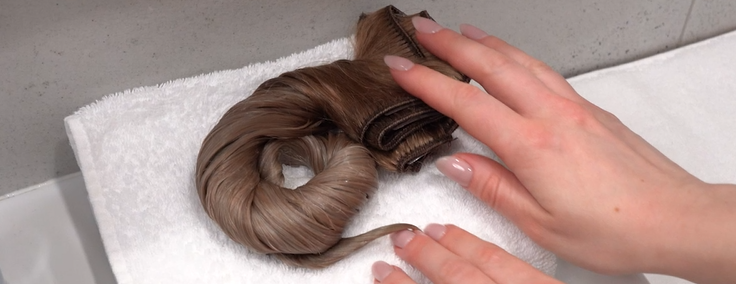
Phase 3: Conditioning and Moisture Sealing for Hair Ends
This step is the “oil-proof layer” to protect the keratin bonds, ensuring that the conditioner does not contaminate the bonds.
- Conditioner/Hair Mask Application: Apply conditioner or hair mask only to the middle and ends of the hair shaft (below the earlobes), avoiding the area around the hair extensions by at least 5-8 centimeters.
- Purpose: The oils and silicones in conditioners are the culprits that break down keratin glue. Keeping them at the ends of the hair provides moisture while ensuring the hair extensions remain secure.
- Second Rinse: When rinsing the conditioner, try to keep your head upright so that the water only rinses the ends of your hair, avoiding prolonged contact of conditioner-laden water with the hair extensions.
- Towel Drying and Blow Drying: Gently press with a towel to absorb excess water (do not rub), and immediately begin blow-drying. Please remember that the bonding areas must be 100% completely dry; otherwise, it may cause odor or loosening.
Post-Wash Maintenance: The Final Inspection
The “Slip & Grip” Check
Moisture-Trap Audit
Tension-Free Detangling
Contact a Full Shine Specialist for Maintenance Support

Written by Skyee, Senior Stylist at Full Shine Hair with 10+ years of extension experience. With over 12 years of hands-on experience in the professional hair industry, Skyee specializes in the application and maintenance of seamless hair systems. As a lead educator at Full Shine, she bridges the gap between salon-grade expertise and at-home care. Her “Support & Stroke” method has helped thousands of clients extend the lifespan of their ultra-thin PU wefts.
Join the #SandwichWash Challenge: See the method in action on our Verified Stylist Channel. We’ve documented over 15,000 successful maintenance routines using this protocol. Tag @FullShineHair in your routine video or search #FullShineCare on TikTok to join our global community of hair extension experts. Still unsure? Book a Live Video Consultation with our lead educators today.


